eCommerce Mobile App Development in Flutter — Complete Guide for Varanasi Businesses (2026)
Step-by-step Flutter eCommerce process · Laravel vs Firebase · Razorpay & COD · admin panel · Varanasi business scope · realistic 2026 costs.


eCommerce Mobile App Development in Varanasi
Selling on Amazon, Flipkart, or Meesho works — until you realise you are paying commission on every order, you do not own your customer data, and your brand is one listing among thousands.
A Banarasi saree seller in Godowlia wants customers in Lucknow and Mumbai to browse her full catalogue with zoom, video, and size filters — not a compressed marketplace listing. A jewellery shop in Sigra wants live gold rate display and appointment booking in one branded app. A sweets brand near Assi wants festival sale push notifications going directly to repeat buyers, not buried in a platform feed.
eCommerce mobile app development in Flutter gives Varanasi businesses exactly this: a direct sales channel, owned customer database, and branded shopping experience — without per-order marketplace commission.
This guide covers the complete development process step by step — from business discovery to Play Store launch — including backend choices (Laravel vs Firebase), payment integration, admin panel setup, realistic costs, and why Varanasi sellers in textiles, jewellery, religious products, and handicrafts are building their own apps in 2026. We build these at Web Developer Kashi (Sigra, Varanasi) using Flutter, Laravel APIs, Firebase, and Razorpay.
Related guides: E-commerce website guide · Mobile app development in Varanasi · Razorpay integration guide · Banarasi saree online selling · Portfolio
The Complete eCommerce App Development Process — Step by Step
Building an eCommerce app is not just about putting products on a screen. It is a structured process with clear stages — each one documented and approved before the next begins.
Step 1 — Business Discovery & Scope Documentation
Before any design or code, the development team maps your business model:
- Single-vendor store or multi-vendor marketplace?
- Product types — physical goods, digital products, services, or a mix?
- Delivery model — local delivery in Varanasi, pan-India courier, or both?
- Payment methods — UPI, cards, COD, or all three?
- Must-have features — wishlist, loyalty points, referral system, live chat?
- Target users — local Varanasi buyers, pan-India customers, or NRI buyers?
Everything agreed here goes into a written scope document — your protection against scope creep and surprise costs later. Never start development without a written scope.
Step 2 — UI/UX Design for the eCommerce App
Design is not decoration — it directly affects conversion rates. For eCommerce apps targeting Varanasi and Tier-2/3 markets, good design means:
- Large product images with zoom and swipe gallery
- Clear category navigation — not hidden behind hamburger menus
- Minimal checkout steps — address, payment, confirm in three taps
- Hindi + English language support where needed
- Works smoothly on mid-range Android phones (not just flagship devices)
Wireframes and screen designs are shared for approval before development starts. Changes at the design stage cost a fraction of changes after code is written.
Step 3 — Backend Architecture Decision
This is one of the most important technical decisions for your eCommerce app. The backend is where your product data, orders, payments, and business logic live.
Step 4 — Backend Development
Laravel Backend — recommended when:
- You need a custom admin panel with detailed reporting
- Multi-vendor marketplace with vendor-wise commission, payouts, and approval workflows
- Complex inventory management — variants, stock alerts, bulk pricing
- Custom business logic — loyalty points, referral systems, coupon engines
- You want full control over hosting, data, and future scalability
- Heavy reporting needs — sales analytics, customer behaviour, vendor performance
Firebase Backend — recommended when:
- You need to launch a single-vendor MVP quickly
- Real-time order status updates are a priority
- Lower initial development cost is important
- Simpler product catalogue, fewer custom business rules
- You're testing the market before scaling to a full platform
Hybrid approach — many eCommerce apps in Varanasi actually use both:
Firebase for authentication and real-time notifications, combined with a Laravel API for orders, inventory, and admin panel logic. This gives the speed of Firebase with the control of Laravel. More on Laravel: Laravel developer in Varanasi guide.
Step 5 — Flutter Frontend Development
With design and backend ready, the actual app development begins:
- Setting up the Flutter project structure with state management (Provider, Riverpod, or Bloc depending on app complexity)
- Building reusable UI components — product cards, category chips, rating widgets
- Connecting to backend APIs for product data, cart, and orders
- Implementing search with filters (price, category, availability)
- Building the cart and checkout flow with real-time price calculation
- Integrating payment gateways
Step 6 — Payment Gateway Integration
For Indian eCommerce apps, payment integration typically includes:
- Razorpay — supports UPI, cards, net banking, wallets in one integration
- UPI deep links — direct UPI app redirection for faster checkout
- Cash on Delivery (COD) — still highly relevant for Tier-2/3 markets like Varanasi and surrounding districts
- Order confirmation and payment failure handling — critical for customer trust
Detailed guide: Razorpay payment integration for e-commerce in India.
Step 7 — Admin Panel Development
A proper eCommerce app needs a backend admin panel for the business owner to manage:
- Product uploads, pricing, and stock updates
- Order management and status updates
- Customer list and order history
- Coupon and discount management
- Sales reports and analytics
- Vendor management (if multi-vendor model)
This is usually built as a web-based dashboard connected to the same Laravel API as the mobile app — similar to how we built the Threpsi Healthcare Laravel e-commerce platform.
Step 8 — Push Notifications & Marketing Features
eCommerce apps depend heavily on re-engagement:
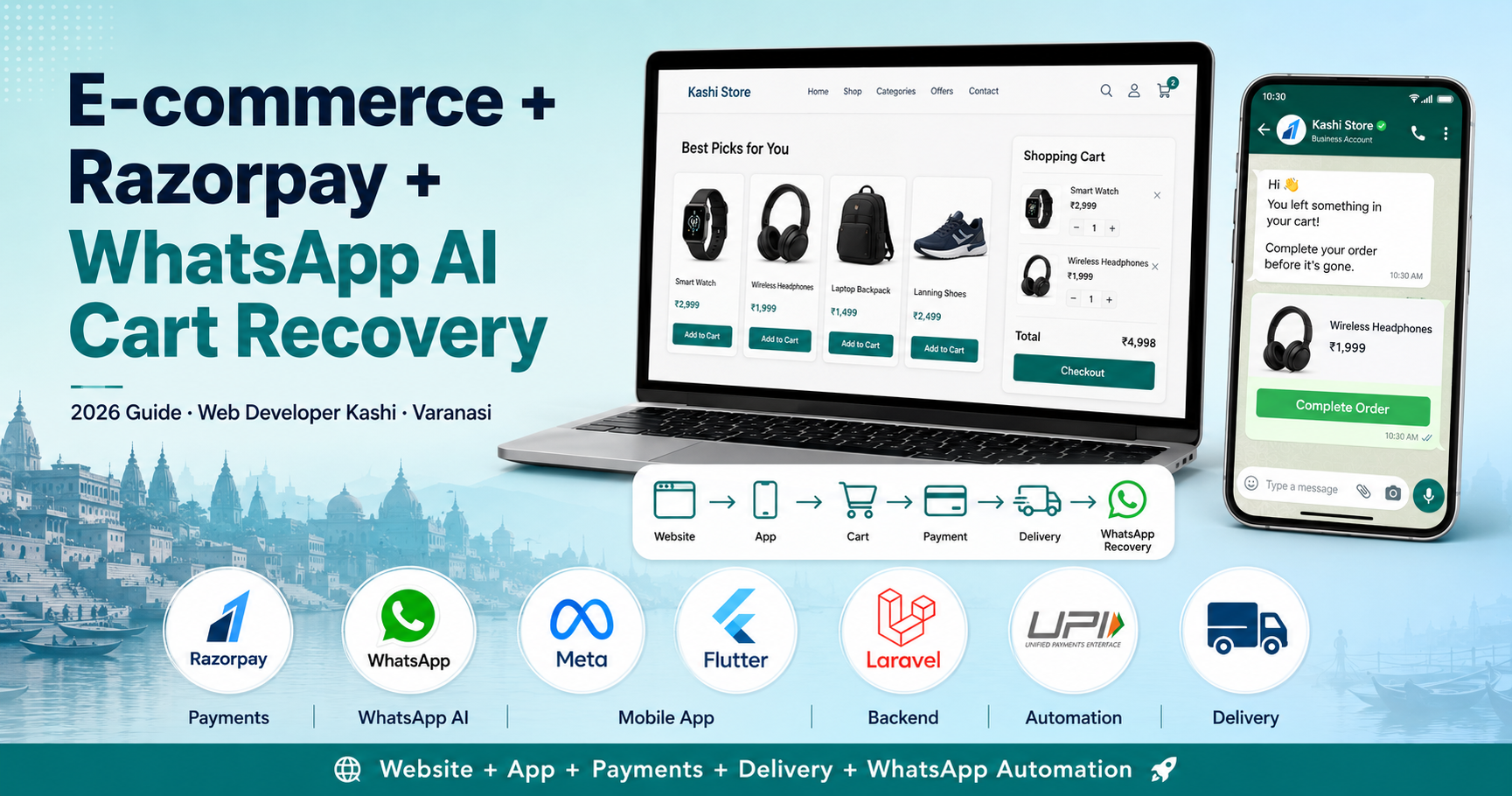
- Firebase Cloud Messaging (FCM) for offer alerts, order updates, and cart reminders
- Abandoned cart notifications
- New arrival and festival sale alerts — especially relevant around Varanasi's high-footfall seasons like Dev Deepawali, Mahashivratri, and wedding season
Step 9 — Testing
Before launch, the app goes through rigorous testing:
- Functional testing on real Android devices across different price ranges (not just flagship phones)
- Payment gateway sandbox testing for all payment methods
- Load testing if high order volume is expected (festival sales, flash sales)
- Network testing — checkout flow must work reliably even on 3G/weak 4G, common in areas around Varanasi
- Edge case testing — out-of-stock handling, payment failures, address errors
Step 10 — Play Store & App Store Publishing
- Google Play Console setup, store listing with screenshots and description
- Mandatory privacy policy page (required for any app collecting user data or payments)
- App signing and secure release build
- Apple App Store publishing if iOS version is also required (separate developer account and review process)
Step 11 — Post-Launch Support & Scaling
Launch is the starting point, not the finish line:
- Monitoring crash reports and fixing bugs quickly
- Adding new features as the business grows — wishlist, referral program, subscription orders
- Scaling backend infrastructure as order volume increases
- Regular updates to stay compatible with new Android/iOS versions
eCommerce Mobile App — Business Scope in Varanasi & Nearby Region
Varanasi and its surrounding districts have a unique eCommerce opportunity that most national platforms don't serve well:
Local Product Categories With Strong eCommerce Potential
- Banarasi sarees and textiles — high-value products where customers want detailed catalogue browsing before buying, locally and for NRI/out-of-city buyers
- Religious and spiritual products — rudraksha, idols, puja samagri, books — strong demand from pilgrims and devotees across India, not just locally
- Sweets and local food brands — gift-able products with festival demand spikes
- Jewellery — live rate display, catalogue browsing, appointment booking combined with online ordering
- Handicrafts and brassware — Varanasi's traditional craft products have national and international buyer interest
Geographic Scope Beyond Varanasi City
An eCommerce app is not limited by physical store location — which is exactly why it matters for Varanasi sellers:
- Mirzapur, Jaunpur, Azamgarh, Gorakhpur — customers in these cities can order from Varanasi-based sellers without travelling
- Allahabad and Lucknow — larger nearby markets where Varanasi brands can build customer base through app-based ordering and delivery
- Pan-India delivery — for products like Banarasi sarees, religious items, and handicrafts, the actual buyer base is national and international, not just local
Why Local Sellers Should Not Depend Only on Marketplaces
Selling only through Amazon, Flipkart, or Meesho means:
- High commission cuts on every sale
- No direct access to customer data or repeat-purchase behaviour
- No control over branding or customer experience
- Complete dependency on marketplace policies and algorithm changes
An owned eCommerce app changes this completely — direct customer relationships, repeat orders through push notifications, and a branded experience that builds long-term business value instead of one-time marketplace transactions.
What a Business Owner Actually Gets From an eCommerce App
If you run a retail, textile, jewellery, or food business in Varanasi and build your own eCommerce app, here is the real, practical impact:
- Direct sales channel — no marketplace commission cutting into your margins
- Customer database ownership — phone numbers, order history, preferences — all yours, usable for remarketing
- Repeat purchase engine — push notifications bring customers back without ad spend every time
- Brand control — your app, your design, your customer experience, not a generic marketplace listing
- Wider geographic reach — sell to Mirzapur, Jaunpur, Lucknow, or anywhere in India without opening new physical stores
- Real-time business visibility — sales reports, best-selling products, and customer behaviour available anytime through the admin panel
- Lower long-term cost — after the one-time development investment, there is no per-order commission like marketplaces charge
Realistic Cost for eCommerce App Development in Varanasi — 2026
| App Type | What's Included | Estimated Cost |
|---|---|---|
| Single-vendor MVP | Firebase backend, basic catalogue, Razorpay/UPI, COD | ₹1,50,000 – ₹3,50,000 |
| Full-featured single-vendor app | Laravel backend, admin panel, push notifications, coupons, reports | ₹3,50,000 – ₹7,00,000 |
| Multi-vendor marketplace | Laravel + Firebase hybrid, vendor panel, commission system, payouts | ₹8,00,000 and above |
| Annual Maintenance (AMC) | Updates, bug fixes, feature additions | 15–25% of build cost per year |
Final pricing depends on number of product categories, payment methods, delivery integrations, and whether multi-vendor functionality is needed. More detail: Mobile app developer in Varanasi — cost guide.

Frequently Asked Questions
Quick answers to common questions. Still need help? We’re just a message away.

WhatsApp, email or a call — pick what is easy.
Conclusion
eCommerce mobile app development in Flutter gives Varanasi businesses a practical, cost-effective way to sell directly to customers — locally and across India — without marketplace commissions or platform dependency.
With the right backend choice (Laravel, Firebase, or a hybrid of both) and a clear development process, a business of any size in Varanasi, Mirzapur, Jaunpur, Azamgarh, or Gorakhpur can build an app that creates long-term, owned business value.
Web Developer Kashi builds eCommerce mobile apps in Flutter with Laravel and Firebase backends, complete with payment integration, admin panels, and Play Store publishing — for businesses across Varanasi and UP.
To discuss your eCommerce app idea, message us on WhatsApp: +91-9696726607 — or visit webdeveloperkashi.com/contact and explore our mobile app development services.
"Your own eCommerce app is not an expense — it is an asset that grows in value with every repeat customer you own."
Get a free quote — ya mobile application development services dekho.