Why 2026 Is the Right Time to Build a Mobile App in Varanasi
Why an app matters now · step-by-step process · Flutter stack · realistic 2026 costs · how to choose the right team.

Why Varanasi businesses are building apps now
Five years ago, having a mobile app was a luxury — only big brands and funded startups could afford it. Today, the situation is completely different.
A jeweller in Sigra is sharing live gold rates through his own app. A coaching centre in Lanka is sending batch updates and collecting fees through a mobile platform. A restaurant near Assi Ghat is running its entire billing and kitchen order system on a Flutter POS app. A tour operator is booking pilgrimage packages through an app his customers downloaded from Google Play.
These are not metro city businesses. These are Varanasi businesses — just like yours.
Mobile application development in Varanasi is no longer a “big budget” decision. It is becoming a basic business requirement. And 2026 is the year when businesses that do not have an app will start feeling the gap — in customer convenience, in operational efficiency, and in competitive positioning.
If you need mobile development in Varanasi (Android, Flutter, Play Store), start on our app development services page — this article is the 2026 process and cost background. We build at Web Developer Kashi (Sigra) using Flutter, Laravel APIs, and Firebase.
Related guides: Best mobile app company in Varanasi · Mobile app developer in Varanasi — cost guide · App vs website vs PWA · Flutter vs React Native · Portfolio
Why 2026 Is the Right Time to Build a Mobile App
Your Customers Are Already on Their Phones
In Varanasi, smartphone usage has crossed every demographic. Your customers — whether they are students, shoppers, patients, or tourists — are spending hours daily on their phones. They book hotels on apps. They order food on apps. They check product catalogues on apps. If your business is not accessible on a phone, you are invisible to a growing portion of your market.
WhatsApp and Instagram Are Not Enough Anymore
Many Varanasi businesses rely entirely on WhatsApp for customer communication and Instagram for marketing. That works — up to a point. But WhatsApp gives you no control over your customer data. Instagram can throttle your reach overnight. You are building on someone else’s platform.
A mobile app gives you your own space — your own branding, your own customer database, your own push notifications, your own payment flow. No algorithm. No dependency on a third-party platform.
Competition Is Catching Up
Your competitors in Lucknow, Allahabad, and even other Varanasi businesses are investing in apps. The businesses that move early build a loyal customer base through their app. Those who wait start from scratch later — at higher cost, with a smaller window to catch up.
App Costs Have Come Down Significantly
Cross-platform technology like Flutter means one development team can build an app that works on both Android and iOS. This has brought down app development costs significantly compared to five years ago. A functional, well-designed business app is now within reach for serious small and medium businesses.
Operations Become Faster and More Reliable
An app is not just for customers. Staff-facing apps for billing, inventory, field reporting, and daily logs save hours of manual work every week. Errors go down. Accountability goes up. Data is available in real time.
Who Needs a Mobile App in Varanasi in 2026?
Almost every category of local business can benefit — but here are the strongest use cases:
Retail and Jewellers
Share live product catalogues, gold rates, new arrivals, and wishlist features. Customers browse at home and walk in ready to buy. Example: Shri Murari Jewellers app on Google Play & App Store.
Hotels and Guest Houses
Let guests check availability, view room tariffs, and send booking enquiries directly through your app. Reduce dependency on OTA platforms and their commissions.
Coaching Centres and Institutes
Manage batch schedules, fee collection, study material distribution, test results, and attendance — all through one app. Students stay engaged. Parents stay informed.
Restaurants and Food Businesses
Run your billing, kitchen order tickets (KOT), table management, and daily reports from a mobile POS app. Works offline. Connects to Bluetooth thermal printers. Example: Mindset Media POS app.
Healthcare and Clinics
Allow patients to book appointments, receive reports, and get follow-up reminders through your app. Build a professional patient experience without investing in expensive clinic management software.
Travel and Tour Operators
Display packages, collect enquiries, share itineraries, and send booking confirmations — all from your branded app. Especially relevant for pilgrimage and religious tour operators in Varanasi.
Logistics and Field Teams
Track delivery status, capture proof of delivery, record GPS location, and submit daily reports — all from a field staff app. No more WhatsApp photos and manual Excel sheets.
How Mobile Application Development Actually Works — Step by Step
Many people think building an app is complicated and unpredictable. It does not have to be. Here is exactly what the process looks like when done professionally:
Step 1 — Discovery and Goal Setting
Before writing a single line of code, you sit down with the development team to answer the most important questions:
- What is the primary purpose of this app — customer-facing or operations?
- Who will use it — customers, staff, or both?
- What are the five most important things the app must do?
- What third-party integrations are needed — payments, maps, SMS, printers?
- Is this Android only, or Android and iOS both?
This conversation shapes everything. A clear discovery session prevents expensive changes later.
Step 2 — Written Scope Document
Everything agreed in the discovery session is written down — the complete list of screens, features, integrations, and what is out of scope. This document is your protection. It ensures the final app matches what you discussed, and there are no surprise additions to the cost later.
Never start development without a written scope.
Step 3 — UI Design
The design phase creates the visual look and feel of your app — screen layouts, navigation flow, colour scheme, fonts, and button placements. Good design is not decoration — it directly affects how easily your customers or staff can use the app. For Varanasi businesses, we keep designs simple and intuitive: large buttons, clear labels, and minimal steps.
Step 4 — Development
This is where your app is actually built. The work happens in two parallel streams:
- Frontend (the app itself) — Built in Flutter for Android and iOS from a single codebase. Screens, animations, user interactions, offline behaviour.
- Backend (the engine behind the app) — Built in Laravel or Firebase. This is where your data lives, your business logic runs, and your admin panel is created. Without a solid backend, an app is just a shell.
Development happens in sprints. You should be able to see working screens as they are built — not wait until everything is finished to see the first result.
Step 5 — Testing
Testing is not optional — it is where problems are caught before your customers find them. Professional testing covers:
- Functionality testing on real Android devices (not just emulators)
- Slow network and no-network conditions
- Payment gateway sandbox transactions
- Hardware integration (Bluetooth printers, barcode scanners) if applicable
- Edge cases — what happens if the user does something unexpected
Step 6 — Play Store Publishing
Launching on Google Play involves more than uploading a file. It requires a properly configured developer account, a compelling store listing with screenshots and description, a privacy policy page (mandatory), app signing with a secure keystore, and submission and review — which can take 3 to 7 days on average. iOS App Store publishing requires an Apple Developer account (₹8,000/year) and follows a stricter review process. We handle both.
Step 7 — Post-Launch Support and Updates
Launch is not the end — it is the beginning. After your app goes live, Android OS updates may affect app behaviour, new features may be requested, and bugs that only appear with real users need to be addressed quickly. An Annual Maintenance Contract (AMC) ensures your app stays updated, secure, and functional without unexpected costs every time something needs attention.
Technology — What We Use and Why
Flutter
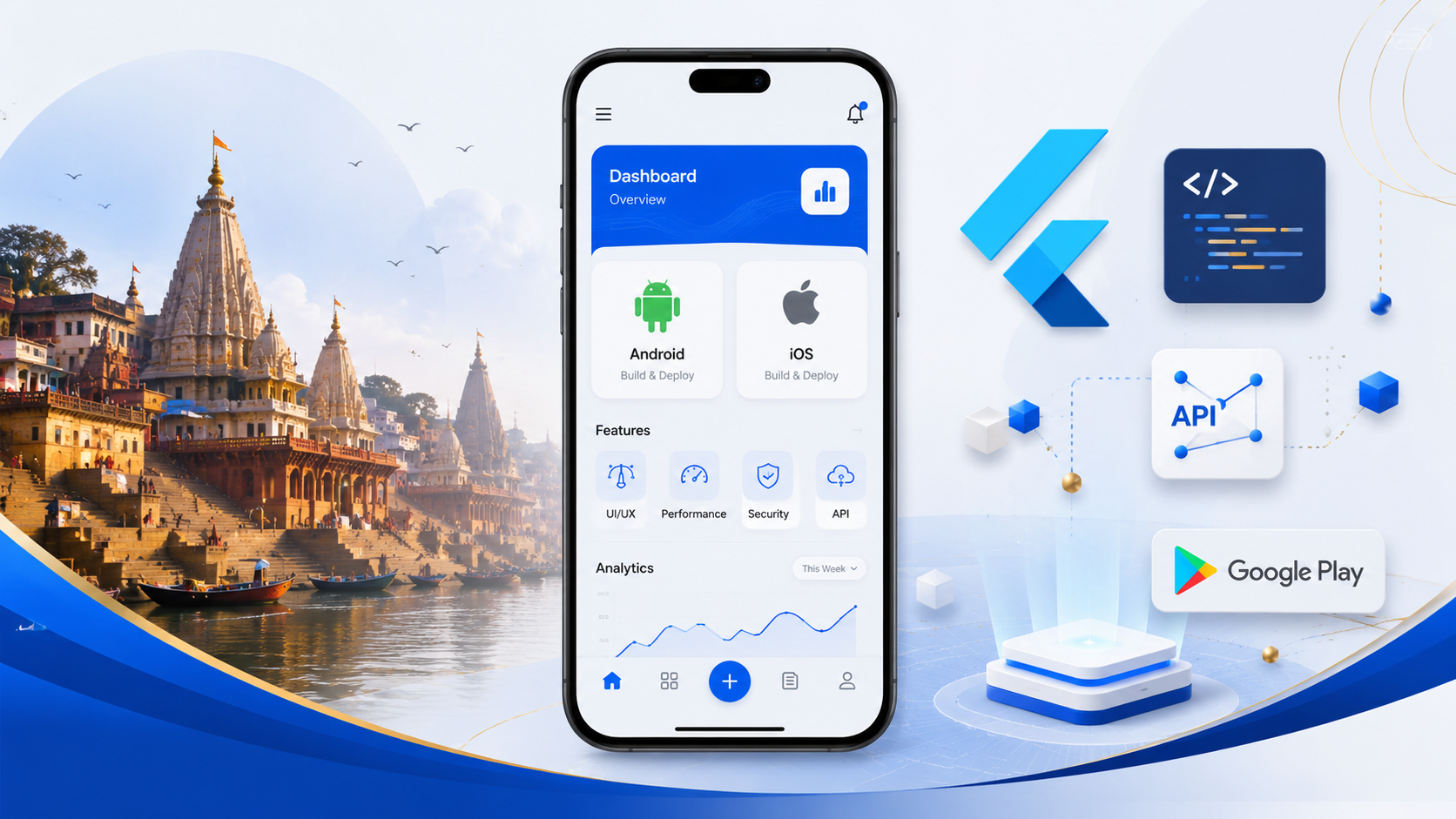
Flutter is our primary development technology for mobile apps. Built by Google, Flutter allows us to write one codebase that runs natively on both Android and iOS. This means lower cost compared to building two separate apps, faster development timeline, consistent design across both platforms, and high performance — Flutter apps feel fast and smooth, not like websites wrapped in an app. Ideal for customer apps, staff apps, POS systems, and most business use cases in Varanasi.
Laravel
Laravel is the backend framework we use for apps that need complex business logic — role-based access, detailed reporting, multi-branch management, or custom admin panels. It also handles Razorpay payment integration, automated emails, and API security.
Firebase
Firebase is Google’s cloud platform, ideal for apps that need real-time data sync, fast authentication, and quick deployment. We use Firebase for MVPs and for apps where speed of launch is the priority.
Payments
All our apps support Razorpay and UPI deep links — the most widely used payment methods in India. We also support Cash on Delivery flows and mixed payment options. Stack comparison: Flutter vs React Native.
Realistic Cost of Mobile Application Development in Varanasi — 2026
Costs vary based on the number of screens, backend complexity, and integrations required. Here are honest indicative ranges:
| App Type | What Is Included | Estimated Cost |
|---|---|---|
| Simple MVP App | Login, listings, forms, WhatsApp/call buttons | ₹80,000 – ₹2,50,000 |
| Mid-Level Business App | Payments, push notifications, admin panel, APIs | ₹2,50,000 – ₹8,00,000 |
| Complex App | Multi-role access, offline sync, POS hardware, marketplace | ₹8,00,000 and above |
| Annual Maintenance (AMC) | OS updates, bug fixes, small feature additions | 15–25% of build cost per year |
A fixed quote is provided only after a proper scope discussion. Anyone who gives you a price without understanding your requirements is guessing. More detail: Mobile app developer in Varanasi — cost guide.
How to Choose the Right Mobile App Development Partner in Varanasi
This decision matters more than the technology you choose. Here is what to check:
- Ask for live Play Store links — Not mockups, not screenshots. Real apps you can download and test.
- Demand a written scope document — Before any payment, everything should be in writing. Screen list, features, timeline, milestones.
- Understand who builds the backend — Many agencies outsource backend development or skip it entirely. Your app needs a proper API and admin panel.
- Confirm post-launch support — Ask specifically: what happens if there is a bug six months after launch? What is the AMC plan?
- Test communication — Can you reach them easily on WhatsApp? Do they respond promptly? Can you meet in person in Varanasi if needed? Post-launch support is only as good as your access to the team.
Frequently Asked Questions
Quick answers to common questions. Still need help? We’re just a message away.

WhatsApp, email or a call — pick what is easy.
Conclusion
Mobile application development in Varanasi is not a luxury anymore — it is a practical business investment for any business that wants to serve customers better, run operations more efficiently, and stay competitive in 2026 and beyond.
The businesses that act now will build a loyal user base, a cleaner operation, and a stronger brand — while those who wait will play catch-up at higher cost.
Web Developer Kashi builds Flutter apps, Laravel APIs, and Firebase backends for businesses across Varanasi and UP. We handle everything from discovery to Play Store publishing — with written scope, transparent pricing, and post-launch support.
To discuss your app idea, send us a message on WhatsApp: +91-9696726607 — or explore our mobile app development services and contact form.
“The best time to build your app was two years ago. The second best time is now.”
Get a free quote — ya mobile application development services dekho.