OJS vs Custom Journal Website: Which Is Better for Research Paper Publication? (2026)
Open Journal Systems or a custom portal — how to choose for submission, peer review and publishing.

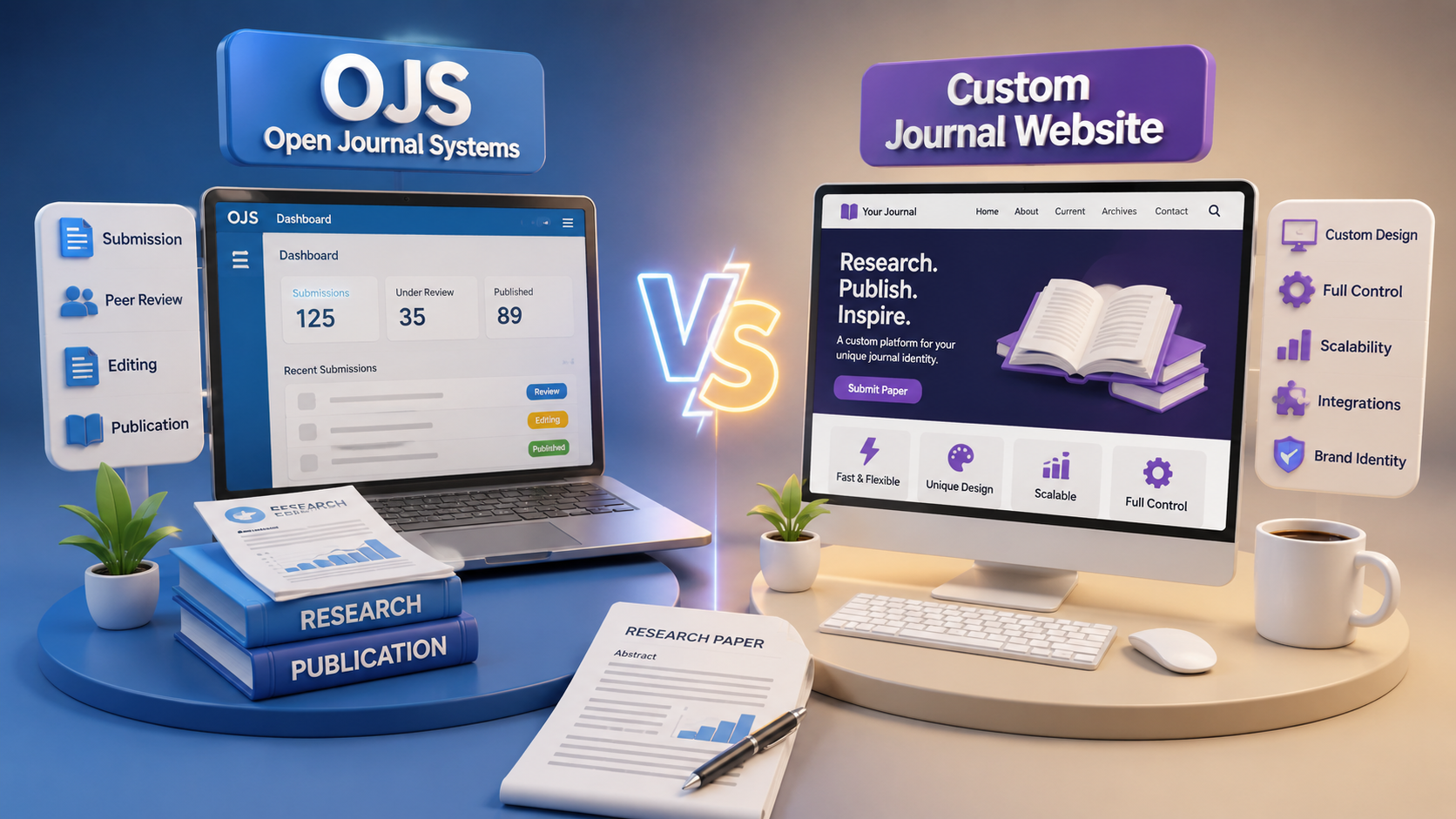
If you are launching a research journal, the first technical decision is often this: use Open Journal Systems (OJS), or build a custom journal website? Both can accept manuscripts, manage editors and publish articles — but they solve different problems. Choosing the wrong path usually means delayed launch, frustrated reviewers, or expensive rebuilds later.
This guide compares OJS and custom journal websites for research paper submission and publication in 2026: workflow, branding, SEO, cost, control, and when a hybrid approach is smarter. At Web Developer Kashi, we help institutes and publishers set up OJS, customise themes, or build Laravel-based journal portals when OJS alone is not enough.
Related: Website development services · Custom vs template websites · WordPress vs custom development
1. What is Open Journal Systems (OJS)?
Open Journal Systems is open-source journal management software used worldwide by universities, societies and research publishers. It is built around scholarly publishing — not generic blogging.
OJS typically supports:
- Author registration and research paper submission
- Editor assignment and peer-review workflows
- Reviewer invitations, revisions and decisions
- Copyediting, production and issue publishing
- Archives by volume/issue, article pages and metadata
- Roles for journal manager, editor, section editor, reviewer and author
For many academic journals, OJS is the fastest way to run a credible submission-to-publication pipeline without inventing every step from scratch.
2. What is a custom journal website?
A custom journal website is built specifically for your journal or publisher — often with Laravel, PHP, or another modern stack. You design the public site, author dashboard, reviewer tools, payment flows and admin panel around your exact process.
Custom builds are useful when you need:
- Unique brand design and marketing pages beyond a standard journal skin
- Special submission rules, multi-journal networks, or conference + journal combos
- Membership, APC/payment gateways, invoices and finance reports
- Deep integration with CRM, LMS, ORCID, Crossref, or internal university systems
- A simpler staff UI than default OJS screens
- Mobile-first author experience with custom notifications (email/WhatsApp/SMS where appropriate)
3. Side-by-side comparison
| Factor | OJS | Custom journal website |
|---|---|---|
| Launch speed | Usually faster for standard journals | Longer — discovery, design, build, QA |
| Peer-review workflow | Built-in and mature | Must be designed and coded carefully |
| Branding & UI | Themeable, but still OJS patterns | Full design freedom |
| Cost (initial) | Lower for setup + theme + hosting | Higher for bespoke development |
| Maintenance | OJS upgrades, plugins, server hardening | Your own codebase + security patches |
| Payments / membership | Possible with plugins/config; limits vary | Easy to design around your business model |
| Long-term control | Strong for scholarly process; UI constraints remain | Maximum product control |
| Best fit | Academic journals with standard publishing needs | Publishers needing unique product experience |
4. When OJS is the right choice
Choose OJS if most of these are true:
- You need authors to submit papers online with peer review
- Editors already understand academic review stages
- You want issues, archives and article metadata without reinventing them
- Budget is limited compared with a full custom product
- Your priority is scholarly workflow reliability, not a flashy marketing site alone
A polished OJS install still needs good hosting, SSL, backups, spam controls, privacy policy pages, and a clean public theme. “Free software” does not mean zero project cost.
5. When a custom journal website is better
Choose a custom journal website if:
- Your submission or review rules do not map cleanly to OJS
- You run multiple products: journal + courses + membership + events
- You need advanced payment, refund, invoice or GST workflows
- Brand experience and conversion pages are as important as the archive
- You want a dedicated mobile app or deep API for partners later
- Staff find OJS too complex and need a simplified operations panel
Custom builds should still respect scholarly essentials: versioned manuscripts, review confidentiality, clear roles, audit trails, and careful handling of personal and manuscript data.
6. The smart middle path: OJS + custom design / hybrid
Many successful journals do not pick an extreme. Common hybrid models:
- OJS + custom theme: keep peer review in OJS; make the public journal look premium.
- Marketing site + OJS: Laravel/WordPress site for homepage, aims & scope, indexing claims, contact — OJS for submission and review.
- Custom portal wrapping OJS APIs / exports: advanced dashboards while OJS remains the scholarly engine (project-dependent).
This often gives the best balance of academic process and brand experience.
7. Features every research journal site should have
| Feature | Why it matters |
|---|---|
| Clear aims & scope | Authors decide if the journal is a fit before submitting. |
| Author guidelines | Reduces incomplete submissions and editorial load. |
| Online submission | Email-only workflows do not scale. |
| Peer-review workflow | Core of research paper publication credibility. |
| Issue / article archive | Readers and indexers need stable article pages. |
| Metadata & SEO basics | Titles, abstracts, DOIs (where used), and crawlable pages. |
| Privacy & ethics pages | Trust for authors, reviewers and readers. |
| Backups & security | Manuscripts and personal data must stay protected. |
8. Cost and timeline (indicative, India 2026)
Exact quotes depend on plugins, custom theme depth, payment features, migrations and hosting. Use these only for planning:
| Option | Typical focus | Rough timeline |
|---|---|---|
| OJS setup + basic theme | Hosting, install, roles, branding, launch checklist | 2–6 weeks |
| OJS + custom theme / marketing site | Stronger public design + OJS workflow | 4–10 weeks |
| Fully custom journal portal | Submission, review, publish, payments, admin | 2–5+ months |
Ongoing costs include hosting, SSL, backups, security monitoring, OJS/core updates, and optional AMC. For broader software budgeting, see our custom software services.
9. Decision checklist before you hire a developer
- How many submissions per month do you expect in year one?
- Do you need double-blind review, sections, or special issues?
- Will you charge APC / membership / print fees?
- Do you need DOI, Crossref, Google Scholar-friendly structure?
- Who will manage the journal day to day — and how technical are they?
- Is branding critical for author acquisition, or is workflow first?
- Do you already have back issues to migrate?
Answer these before comparing quotes. Otherwise every vendor sells a different product under the same word “journal website”.
10. How Web Developer Kashi can help
From Varanasi, we support research publishers and institutes with:
- OJS installation, configuration and training-oriented setup
- Custom OJS theming and a professional public journal presence
- Marketing website + OJS hybrid architecture
- Custom Laravel journal / submission portals when OJS is not the right fit
- Hosting, security hardening, backups and maintenance plans
Share your aims & scope, expected volume, and whether you need peer review in phase one — we will recommend OJS, custom, or hybrid honestly. Start with a free consultation.

Frequently asked questions
Quick answers to common questions. Still need help? We’re just a message away.

WhatsApp, email or a call — pick what is easy.
Conclusion
OJS wins when your priority is a proven research paper submission and peer-review system. A custom journal website wins when your publishing product needs unique UX, payments, integrations or multi-product operations. For many institutes, the best answer is a hybrid: OJS for scholarly workflow, custom design or marketing site for brand and author acquisition.
Get a free consultation — or WhatsApp +91 96967 26607 with your journal name and requirements.