Clinic and Hospital Mobile App Development in Varanasi (2026)
Appointments, doctor schedules, reports, reminders, payments and secure patient experiences.

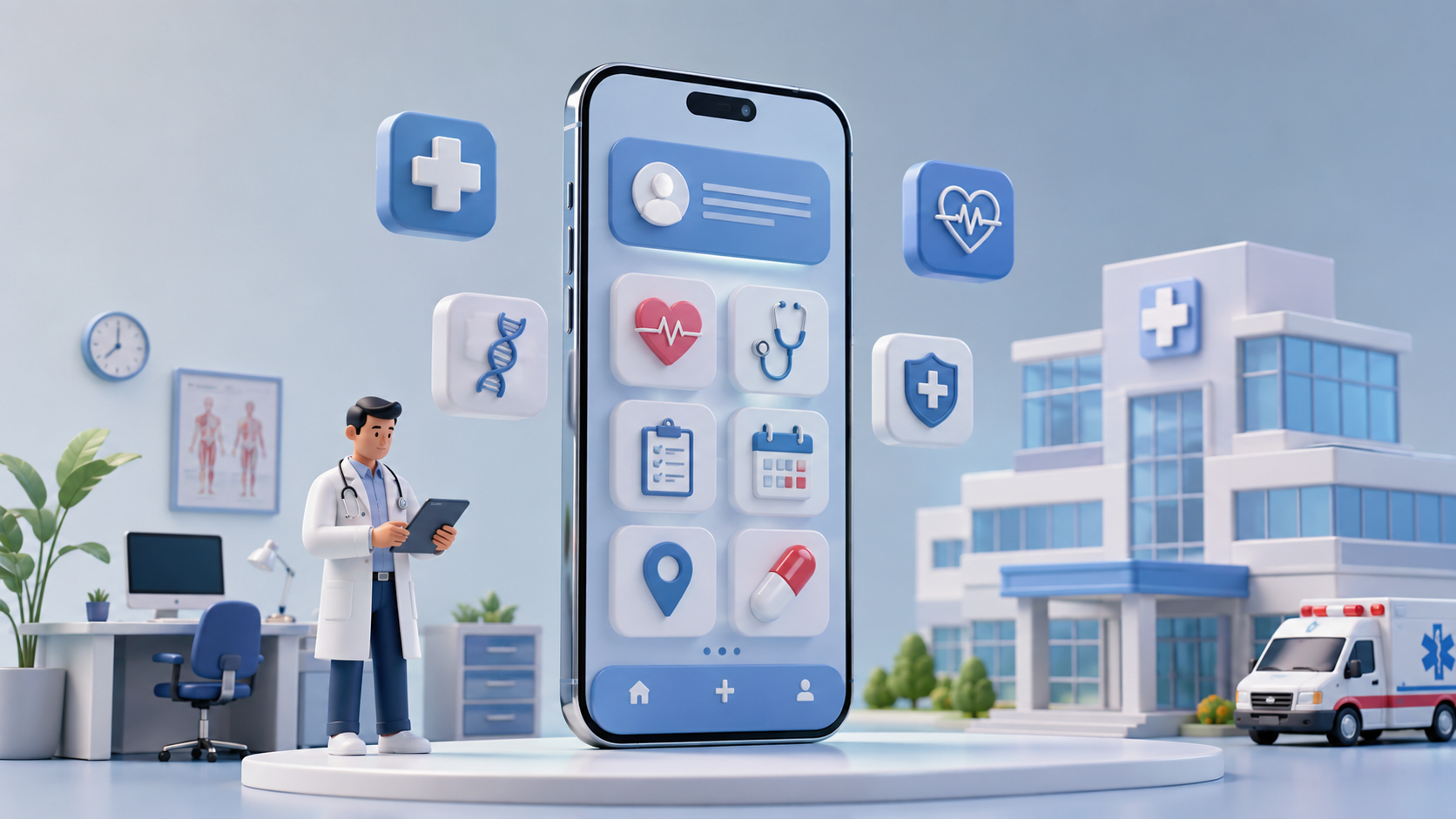
Patients in Varanasi increasingly expect a quick way to find a doctor, check an available slot, book an appointment and receive updates on their phone. At the same time, reception teams need fewer repeated calls and a clearer daily schedule. A thoughtfully planned clinic or hospital mobile app can connect these two needs without making healthcare workflows more complicated.
This guide explains clinic and hospital mobile app development in Varanasi from a business and technical perspective: which features create value, what an MVP should contain, how a mobile app connects with a website or management system, what privacy questions to ask, and what affects development cost in 2026.
Related resources: Mobile app development services · Clinic management software guide · Hospital and clinic website guide · How to choose an app company in Varanasi
Why clinics and hospitals are investing in mobile apps
A mobile app is most useful when patients or staff return frequently. It should solve a repeat workflow—not exist only because competitors have one. For a single-doctor practice, a responsive website and WhatsApp appointment flow may be enough initially. For a multi-doctor clinic, diagnostic centre or hospital, an app becomes more valuable when it reduces operational friction.
- Fewer appointment calls: patients can view slots and request or confirm bookings.
- Better schedule visibility: doctors and reception can see day-wise appointments.
- Timely reminders: notifications can reduce forgotten visits and missed follow-ups.
- Easy access: patients can find directions, contact details, services and reports in one place.
- Stronger patient retention: repeat bookings happen through the clinic's own branded channel.
- Operational insight: authorised teams can review appointment volume and service demand.
Essential features for a clinic mobile app
A small or mid-sized clinic should begin with a focused MVP. Adding every possible feature on day one increases cost and makes staff training harder. The following modules cover the highest-value patient journey.
| Feature | Business value |
|---|---|
| Patient registration and login | Creates a secure account using mobile number, email or an approved authentication flow. |
| Doctor profiles | Shows speciality, qualifications, timings and consultation information clearly. |
| Appointment booking | Lets patients choose a doctor, date and available slot without repeated calls. |
| Token or queue status | Helps reduce unnecessary waiting when the clinic workflow supports live updates. |
| Reminders and notifications | Sends appointment, follow-up, vaccination or report-ready updates with consent. |
| Online payments | Supports consultation or booking payments through an approved gateway such as Razorpay. |
| Reports and prescriptions | Provides controlled access to documents when the clinical and legal workflow permits it. |
| Contact, emergency and directions | Displays correct phone numbers, location and emergency guidance without hiding them behind login. |
Additional modules for hospitals and diagnostic centres
A multi-specialty hospital needs more than an appointment screen. Different departments, branches and user roles create additional complexity. These features are usually planned in phases:
- Department-wise doctors, services and availability
- Lab test booking, sample collection requests and report status
- Health packages and preventive check-up booking
- Multi-branch selection with maps and contact details
- Doctor or staff app for schedule and appointment updates
- Role-based dashboards for reception, doctors and administrators
- Teleconsultation integration where the provider's process and applicable requirements support it
- Integration with existing HIS, EMR, billing or laboratory systems through secure APIs
An app should never present itself as a replacement for emergency medical services. Emergency numbers and hospital instructions must remain clear, and automated content should not be designed to diagnose patients.
Patient app, doctor app and admin panel: three connected parts
Many buyers think only about the patient-facing screens. In practice, a healthcare app usually needs three connected products:
- Patient mobile app: registration, doctors, booking, payments, reminders and documents.
- Doctor or staff interface: schedules, appointment status and permitted patient information.
- Web admin panel: doctors, departments, slots, banners, notifications, reports and access control.
The backend keeps all three in sync. A custom Laravel API and admin system can suit complex workflows, while Firebase can help with authentication, notifications and selected real-time use cases. Technology should follow the workflow—not the other way around.
Clinic app vs clinic management software vs website
These products solve different problems and often work best together:
| Product | Primary purpose |
|---|---|
| Healthcare website | Google visibility, doctor and service information, trust, maps and first-time enquiries. |
| Patient mobile app | Repeat booking, reminders, reports, payments and an ongoing patient channel. |
| Clinic management software | Internal appointments, billing, records, staff roles and operational reports. |
A new clinic should usually establish a fast healthcare website and a reliable internal process before investing in a full patient app. A growing multi-doctor practice may benefit from connecting all three through one backend.
Privacy and security must be part of the first scope
Healthcare information is sensitive. Security cannot be added only after development. Before collecting patient data, the clinic or hospital should define why each field is needed, who can access it, how long it is retained, and how a patient can request correction or deletion where applicable.
- Data minimisation: collect only information required for the stated service.
- Role-based access: reception, doctor and administrator should not automatically see the same data.
- Encryption: protect data in transit and use appropriate protection for stored sensitive information.
- Consent and notices: explain how information and notifications will be used.
- Auditability: record important access and administrative actions where required.
- Backups and recovery: test restoration, not only backup creation.
- Secure integrations: avoid sharing patient information through undocumented or unsecured APIs.
The healthcare provider remains responsible for its legal and clinical obligations. Product teams should work with the provider's legal, compliance and medical stakeholders when the app handles health records, telemedicine, insurance or regulated integrations.
Mobile app development process for a Varanasi healthcare provider
- Workflow discovery: map the current patient journey, reception process and staff roles.
- MVP scope: separate launch essentials from phase-two features.
- Wireframes and prototype: test booking and cancellation flows before coding.
- Backend and access design: define data, APIs, permissions and integrations.
- Flutter app development: build Android and iOS from a shared codebase where suitable.
- Testing: check real devices, slow networks, notifications, payment failures and access rules.
- Store publishing: prepare privacy policy, screenshots, descriptions and reviewer access.
- Training and launch: train reception and administrators before inviting patients.
- Maintenance: monitor crashes, update dependencies and plan feature improvements.
How much does a clinic or hospital app cost in Varanasi?
Cost depends on the number of user roles, integrations, privacy requirements, custom design and whether an existing backend is available. The following ranges are useful for initial planning, but a written discovery is needed for an accurate quote.
| Project type | Indicative range | Typical scope |
|---|---|---|
| Clinic appointment MVP | ₹1.5L–₹3L | Doctors, slots, booking, reminders and basic admin |
| Patient service app | ₹3L–₹8L | Payments, reports, notifications, roles and custom dashboard |
| Hospital or multi-branch platform | Custom estimate | Multiple departments, staff tools, integrations and advanced controls |
Hosting, SMS or WhatsApp messaging, payment gateway charges, developer accounts and ongoing AMC are normally separate recurring costs. For broader pricing factors, read our mobile app cost and company guide.
How to choose a healthcare app developer in Varanasi
Do not choose only by the lowest quote. Ask potential developers to explain both patient experience and backend operations.
- Can they build the app, API and admin panel as one system?
- How will roles, permissions, consent and audit requirements be handled?
- Can they integrate with your existing software through documented APIs?
- Who owns the source code and deployment accounts after full payment?
- Are Play Store and App Store publishing included?
- What does the post-launch AMC cover?
- Will they provide milestone demos on real devices?
Compare mobile app companies using this complete checklist before signing a contract.
How Web Developer Kashi can help
Web Developer Kashi develops custom Flutter applications from Sigra, Varanasi, supported by Laravel APIs, Firebase services and web admin dashboards. We can plan a patient app alongside your clinic management software and hospital or clinic website so appointments and content do not remain scattered across disconnected systems.
We begin with workflow discovery and recommend a smaller MVP when a full hospital platform is not yet justified. Our mobile app development service includes planning, UI, Flutter development, backend integration, testing, store publishing support and optional maintenance.
Frequently asked questions
Quick answers to common questions. Still need help? We’re just a message away.

WhatsApp, email or a call — pick what is easy.
Conclusion
Successful clinic and hospital mobile app development in Varanasi begins with the patient and reception workflow—not a long feature list. Start with a useful MVP, protect sensitive data from the first design, connect existing systems through secure APIs, and budget for maintenance after launch.
Request a free consultation or send your requirements on WhatsApp.